
“Mind-Food”
Part Two of how home education contributed to my spiritual journey.

When wisdom enters your heart and knowledge is pleasant to your soul, discretion will preserve you; understanding will keep you.” —Proverbs 2:10 [emphasis mine]
In my previous post, I talked about how educator Charlotte Mason’s ideas—presented beautifully by Susan Schaeffer Macaulay in her book, For the Children’s Sake—influenced not only our family’s educational (and my spiritual) journey but also my future psychological healing.
I focused on Mason’s “children are born persons” concept and also touched on how increasing “living books” and decreasing “twaddle” helped our oldest child (and subsequently all of our kids) want to read.
In addition, I mentioned how parents and teachers can create a positive “learning atmosphere” for children by:
being good role models,
establishing comfortable routines (“habits”),
and providing worthwhile, intellectually stimulating sustenance (“mind-food”).
In this post, I want to share how we endeavored to create that kind of learning atmosphere in our home.

But first…
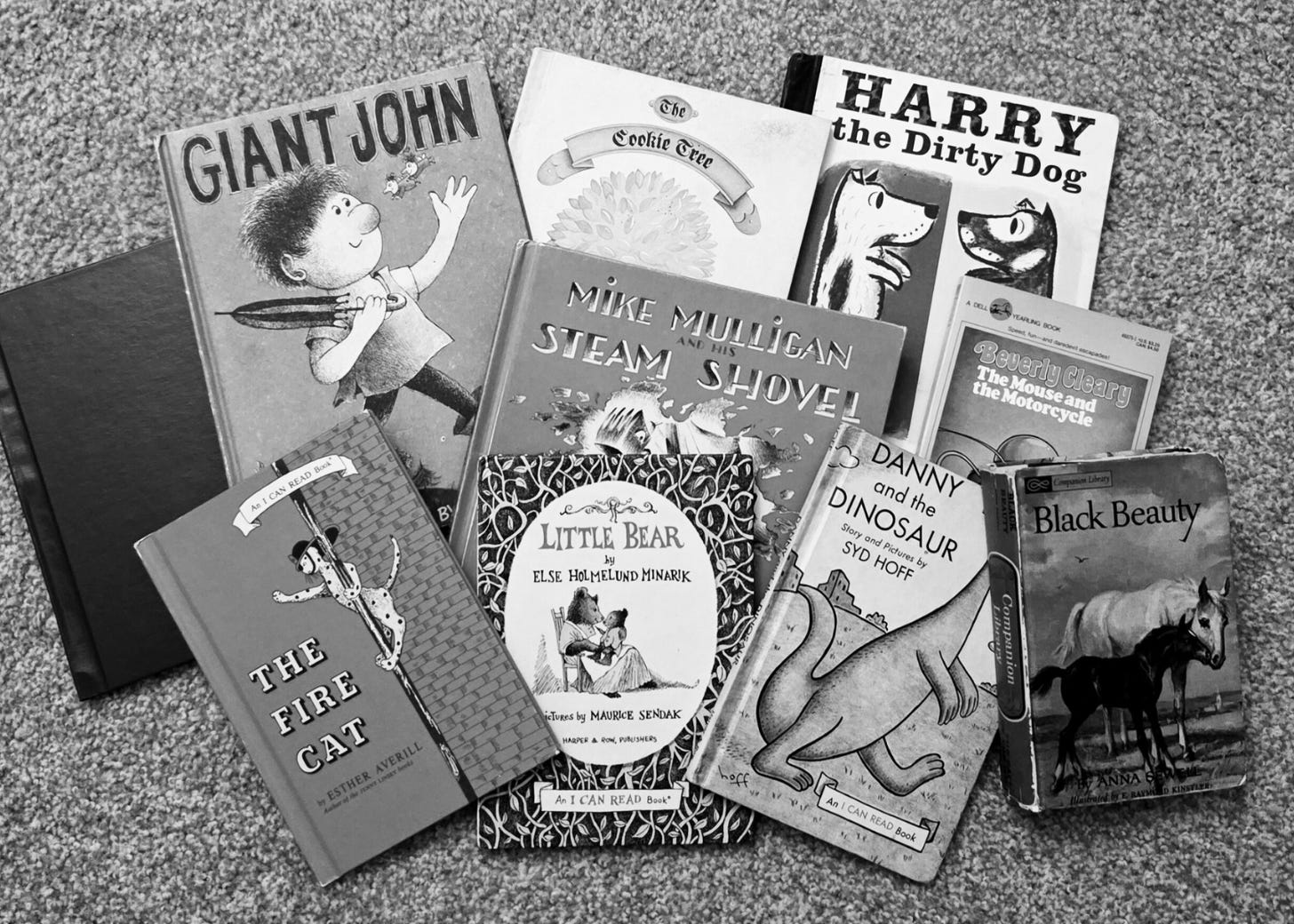
In Part One, I said that I already had a love of literature before being introduced to Charlotte Mason. I have fond memories of my mother reading to me as a child. The books pictured above were some of my favorites, although, my Frog and Toad books, Misty of Chincoteague series, and Nancy Drew mysteries are sadly missing.
Even worse, I no longer have my most-loved picture book, Miss Suzy, written by Miriam Young and illustrated by Arnold Lobel.
Hold on.
Okay, I checked to see if Miss Suzy was still in print and they published a 60th Anniversary Edition last year! Fast-forward a few days, and it is now back in my possession.
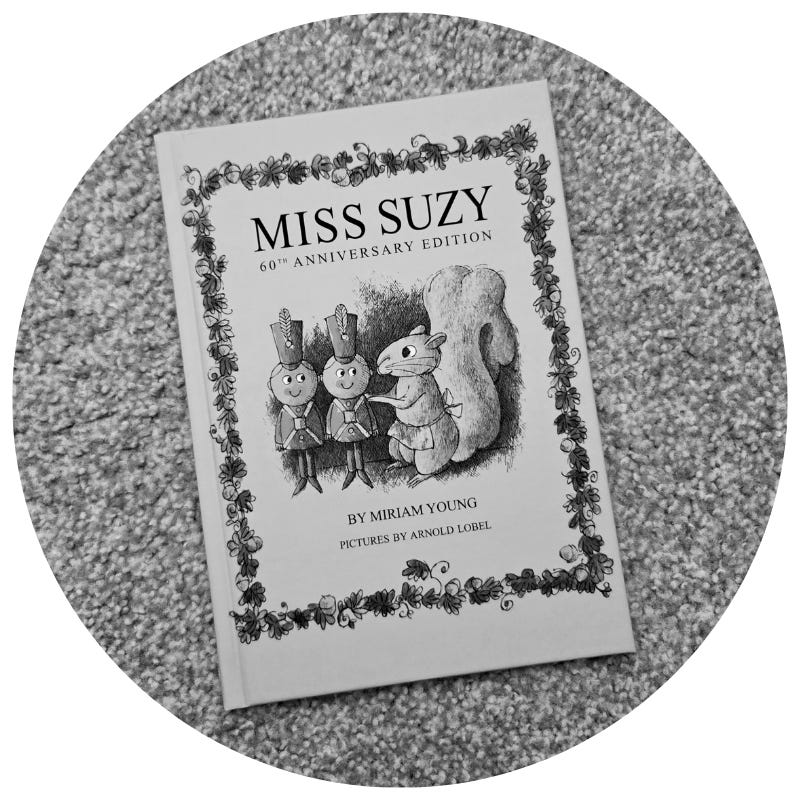
Having a physical copy of the adored Miss Suzy makes me smile. As a child, I never tired of hearing about the little, gray squirrel who contentedly lived “in the tip, tip, top of a tall oak tree” where she liked cooking and cleaning and singing while she worked (it tickled my grown daughter to learn Miss Suzy was my favorite picture book when—despite my ambition in my twenties and thirties to be a “traditional” wife—I never have been domestically-inclined).
Miss Suzy, however, was not your typical stay-at-home squirrel. She lived happily alone in her tiny treehouse, completely supporting herself, until a band of nasty, red squirrels chased her from her treetop abode. After escaping to the attic of a nearby house, Miss Suzy would go on to free a group of toy soldiers and invite all six of them to live with her in the large dollhouse she’d made into a temporary dwelling (granted, she acted more like a mother to them but still, not your conventional family arrangement!). The toy soldiers later helped Miss Suzy reclaim her beloved home, and the story ends with our brave and caring gray squirrel once more living comfortably on her own, admiring her firefly lamps and acorn cups (and the soldiers visited from time to time).
My mother reading to me naturally led to reading on my own (I have no memory of learning to read—it just seemed like I always could), and I would continue to read various titles for pleasure until my teens when I lost interest in most books except the Bible.
Three main events in my adult life reawakened my desire for literature and learning in general (which was like the fertilizer for my soul’s future growth). I’ve talked more about them in other posts but to recap, they were:
Meeting a beloved mentor and his wife in my mid-twenties.
Reading An Education of a Wandering Man the year before I turned thirty.
Homeschooling according to Charlotte Mason’s principles which came to fruition in my mid-thirties.
For the foreseeable future, I want to focus on the period between my mid-thirties and early-forties—before D and I separated in 2003. In many ways, it was a glorious time, and I hope some of that is made apparent below. It was not all wonderful, however, and I’ll share certain regrets in the next post.
“Education is an atmosphere, a discipline, a life.”
“Much of teaching consists in supplying a steady diet of good quality nourishment for [children’s] minds and hearts.” —Susan Schaeffer Macaulay
Attempting to live by the principles in For the Children’s Sake, D and I steadily built our family’s version of a vibrant, “learning atmosphere.”
To give you a glimpse of what that was like, I’m including some excerpts. The first is from an email I wrote to a long-distance homeschool friend in 1996—my kids were ages 12 (almost), 10, 7, and 6:
An example of what we do: for the last seven months, we have been learning about the Ancient Greek civilization. I typically read a source book on the time period [often from Usborne], then literature set in the time period, then literature written during the time period (and I throw in any videos I can find, too). So, for a few months, we really “live” in the time period.
I read Socrates by Robert Silverberg to [our oldest two kids] and that book sparked many good discussions. Then I read The Greek Armies by Peter Connolly, The Heroes by Charles Kingsley, and The Macmillan Book of Greek Gods and Heroes (which our youngest two also listened intently to) and right now we’re two-thirds through Homer’s The Iliad, which is wonderfully translated by Robert Fitzgerald.
All of this has been great fun. Sometimes the children play they are Akhaians or Trojans, and we hear things like “Get to the ship, Diomedes,” “Odysseus, throw your spear!” “Oh no! Here comes Hektor!” coming from the playroom…
Because of all the present emphasis on Greek history…our oldest decided to read The Odyssey (he has liked informing us of things we don’t know yet, such as how Agamemnon meets his death). If he tires of the story, and puts it aside for a while, it won’t bother me. He’s only eleven-years-old. As he matures he will become more determined in his reading. Besides I don’t usually finish a book unless I’m interested in it…
Sometimes, if I want the children to become interested in something they aren’t yet (like geography), I buy a game like Aristoplay’s Where in the World) or I’ll read a well-written book on the subject. So far, none of the children have a passion for science so, occasionally, I read books like The Animals of Doctor Schweitzer by Jean Fritz or the fictional The Twenty-One Balloons by William Pène du Bois. We also watch many science and nature videos.
Also, and I think this might be the most important thing—because [D] and I are excited about learning for ourselves, our example has greatly influenced the children…
It works something like this: Everything leads to something else. A beautiful concerto by Bach leads me to listen to other pieces by Bach. I learn that Bach was rediscovered by Mendelssohn. I listen to music by Mendelssohn. Mendelssohn composed the lovely, “A Midsummer Night’s Dream” so I read Shakespeare’s A Midsummer Night’s Dream… [Edited to add: I then checked out a videoed performance from the library and the kids enjoyed it—an oft-quoted line being Helena’s, “I’m as ugly as a bear.” Though I should say “some” of the kids enjoyed it. When my daughter read the draft of this post, she reminded me that it was Much Ado About Nothing that made her fall for Shakespeare. She ditched watching Midsummer (and is still not a fan of any productions of it) to help D make bourbon balls in the kitchen.]
The second excerpt is from around the same time and was shared with an acquaintance on an online forum:
Much of this “learning atmosphere” takes a lot of planning on my part! I have to make sure to put in the music tape, to read-aloud to the children, to play outside with them, to take time to be a learner myself… I don’t force our children to watch an orchestra play Mozart on TV. I love Mozart. I watch the program. And, lo and behold, I usually have four kiddos watching with me (and when they get tired, they jump up and go play the Trojan War in the playroom!).
Also, I have to follow up on their individual interests—make resources available, put them in touch with people who are in that field, etc. So I have to plan, plan, plan to expose my children to a seemingly spontaneous abundant life. <smile> It doesn’t just happen… But don’t let me make us sound perfect. There are times when I think I’m living in a house full of yahoos (myself being the biggest one!). But, I tell you. We are having a ball.
Ah, memories! Home education was often a delight but also a lot of effort. One particular challenge: D worked at a chemical plant for a number of years and had a “really strange” schedule. I described it to my pen pal like this: “He works three 12-hour days then he is off for three days, works four 12-hour nights, is off for two days, works two days, off three days, works three nights, off four days.” Somehow, he still managed to share his love of history (especially of the Civil War), music (he introduced all of us to Rush, Stevie Ray Vaughan, and Loreena McKennitt), mixed martial arts (and Bruce Lee movies), and Kimchi (he made it himself using his mother’s recipe).
And we did use some traditional methods. I thought of us as “semi-unschoolers” (unschooling meaning child-led education) because math lessons were required. Also, writing was a bit more structured, especially as the children got older, although, we still prioritized joy.
“Education isn’t just about filling minds... It’s about shaping hearts, nurturing wonder, and cultivating a love for truth, goodness, and beauty.” —Susan Schaeffer Macaulay
Before closing this part, I want to share a couple of additional passages. Similar to the excerpts above, the below two snapshots (written ten years apart) encapsulate our learning lifestyle. And as I move forward in chronicling my spiritual autobiography, keep in mind that the things that influenced my journey (every theological or philosophical book I read, and every insightful or thought-provoking conversation I had) were couched within and inspired by our family’s unique culture. It was all one grand adventure—relational, educational, emotional, and spiritual.
So, here’s the next passage. It’s from an email I wrote to a friend in August of 1996:
We started our “structured” schooling (math and Latin) again today. [Our oldest] does have a more intense schedule this year (he is determined to take college classes early) but, I tell you, I love this unschooling method of homeschooling. Today, as I was going upstairs to talk about syllables, feet, and meters with [our oldest], I passed by [our second son] reading Robin Hood, [our daughter] watching a video of The Sleeping Beauty ballet, and [our youngest] playing “army man.” What a life!
The last one is from a June 2006 blog post when the kids were ages 22, 20, almost 17, and 15 (and the friend I mention is the same person who was a student in my Sunday School class and went on to become a long-term kindred spirit):
Had dinner last night with [a dear friend]. I can’t count how many times I started a sentence with, “My daughter and I were just talking about…” or “my youngest and I had a conversation the other day…” or “the kids and I discussed that very thing and…”
Recent topics covered in the car, at the kitchen table, or while sitting on someone’s bed:
honesty in communication, honesty in relationships, just honesty in general
whether or not we can know our true likes and dislikes without being influenced by peer pressure, media opinion, and our own blind spots
do we have an unchangeable core self
how the best way to be selfish is actually to put the needs of the group ahead of our own
sexuality (you name it, we’ve talked about it)
does God have an ego
is there even a God to begin with
whether a Guild Wars character resembles a certain Japanese bassist
and whether explosively loud burping is universally offensive
I often wonder what our country would be like if we all went 'back to school' as adults, you know? Frog and Toad, oh my gosh, they were my first 'book report' in elementary school, I loved them. I enjoy reading your story so much. Like you, I find myself grateful for the time I learned right along with my children while homeschooling, layered learning like you explain, everything touching everything and we shared a common narrative for family discussions. I grew so much at that time and read literature, discovered I loved math, and still can't read enough.
Ikr? Keep the curiosity alive into adulthood.