
"What! You too? I thought I was the only one." -C.S. Lewis
Part Three of my series on what C.S. Lewis meant to my spiritual journey.


When I recently flipped through my decades old paperback copy of C.S. Lewis’ book, The Four Loves, the pages appeared basically untouched. Nothing was underlined or highlighted. Only a few comments decorated the margins. I searched to see if I’d written separate notes for it. I couldn’t find any. Strange. Very unlike the me of 1996 (or 2026 for that matter).
Once settled on our living room couch, book in hand, I skimmed more slowly through the “Introduction.”
Wait. What is that? A speck of yellow?
I grabbed my phone, turned on its bright flashlight, and pointed it at the paper. Aha! I had highlighted throughout. It’s just that after 30 years (or 10,950 days!), the yellow ink had faded and couldn’t be seen in normal light.
Originally, I had not planned on rereading The Four Loves. Now, I needed to know what I’d highlighted all those years ago. So, with the continued assistance of my phone’s luminosity, I started at the beginning and marked the passages that I’d emphasized in the past—except this time with a ballpoint pen’s black ink!
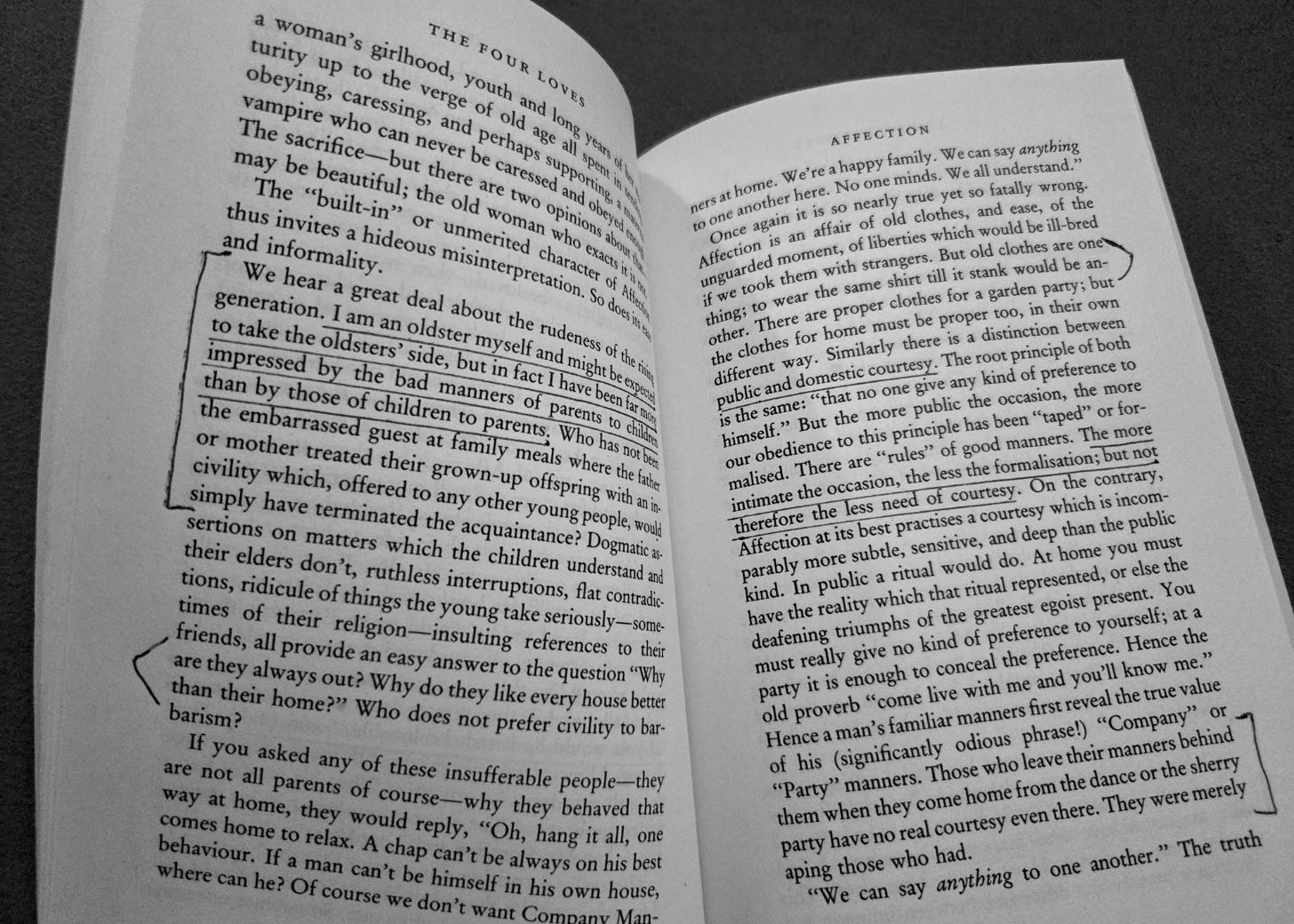
I had planned to write about the book, but I was thinking I’d simply cover a few quotes from the chapter on friendship. After rereading about 40 pages, however, I realized that, nope, I was going to write about all of it. Too much good (and not so good) stuff. Too many vivid memories.
So, in this post, I’ll comment on the “Introduction” and the following three chapters: “Likings and Loves for the Subhuman,” “Affection,” and “Friendship” (the latter taking up most of my focus). In a future post (or posts) I’ll address the final two chapters, “Eros” and “Charity.”
Here we go.
Introduction
The first line I re-highlighted is the first line of the entire book: “‘God is love,’ says St. John.” If I could, I’d ask my 1996 self what those words meant to me, although, I’m pretty sure that part of my answer would’ve included echoing thoughts that C.S. Lewis shares a few pages later. He writes (rewording a quote by M. Denis de Rougemont): “…’love begins to be a demon the moment he begins to be a god.’” Lewis then adds: “If we ignore [de Rougemont’s idea then] the truth that God is love may slyly come to mean for us the converse, that love is God.”
This time around, I added a comment in the margin that wasn’t there before. Beside Lewis’ “love is God” statement I penned, “Yep!” Because these days, that is what I believe—that wherever there is real love (not selfish words or actions masquerading as love) God is there. Made manifest. Present.
I do get Lewis’ worry that some might make an idol out of a feeling—thinking that anything done “for love’s sake” is automatically divine. Still, for me, it’s like when Jesus said if we feed the hungry, clothe the poor, care for the sick, welcome the stranger, and visit those in prison then we’re doing those things to Him. That’s sort of how I imagine that God is love, therefore, love is God. To me, benevolent love is always sacred in nature.
But enough about what I believe now. Back to my journey then.
Likings and Loves for the Sub-Human
In this chapter, Lewis sets the stage for discussing the four categories of love (Affection, Friendship, Eros, Charity). He does so by exploring likings and loves that are not directed toward people, such as love of nature or love of country or, in my case, love of books, music, art, film, dance, and white chocolate truffles. In other words, “Appreciative pleasure.”
Contrasting the “Pleasures of Appreciation” with what Lewis calls, “Need-pleasures,” he says that where enjoying something out of pure need or necessity can be temporary (“The smell of frying food is very different before and after breakfast”), Appreciative Pleasure is more enduring and makes us “feel that something has not merely gratified our senses in fact but claimed our appreciation by right… We do not merely like the things; we pronounce them, in a momentarily God-like sense, ‘very good.’” And that, he contends, is the starting point for our whole experience of beauty.
The me of 1996 ate up this chapter. My Personal Renaissance was well underway and though Lewis spoke here of his love of nature instead of his love of literature, I related to what he shared. Replace his word “nature” with my phrase “the arts” in the excerpt below and you’ll see what I mean.
“Nature never taught me that there exists a God of glory and of infinite majesty. I had to learn that in other ways. But nature gave the word glory a meaning for me. I still do not know where else I could have found one… And if nature had never awakened certain longings in me, huge areas of what I can now mean by the ‘love’ of God would never, so far as I can see, have existed.” —C.S. Lewis
Affection
The first of the four main loves is Affection, and Lewis informs us that the Greeks called this humble sentiment, “Storge.” It’s the warm, comfortable fondness we feel for people and animals. Lewis says that The Wind in the Willows’ “quarterion” of Mole, Rat, Badger, and Toad is an example of the “amazing heterogeneity possible between those bound by Affection” (also, that reference probably tickled 1996 adult me because, just two years before, I’d read Kenneth Grahame’s classic story for the first time).
According to Lewis, affectionate love:
often has no genesis or commencement that we can point to
is conferred upon those we’ve been thrown together with (family, schoolmates, co-workers, members of organizations we belong to)
has an ordinary quality and charm (“No need to talk. No need to make love. No needs at all except perhaps to stir the fire.”)
and can be taken for granted
Thinking of that last point—when illustrating how Affection can sometimes be assumed, even demanded, by those who least deserve it, Lewis references Samuel Butler’s semi-autobiographical novel (published posthumously in 1903), The Way of All Flesh. And woah. I’d forgotten Lewis had introduced me to that book. I would read it four years later at the turn of the millennium, and it would be a watershed moment in my deconversion process. The title was most likely added to my TBR list because of its mention by C.S. Lewis (thank you, Jack!).
The Way of All Flesh critiques Victorian hypocrisy and satirizes its institutions (such as the church and the education system). It’s also said to be a precursor to 20th-century literature. It was certainly a precursor to one of the most intense periods of my life when I re-examined almost everything I ever believed.
Before moving on, I want to share one last passage from this chapter. Talking about how “change is a threat to Affection,” Lewis writes…
“The jealousy of Affection is closely connected with its reliance on what is old and familiar… We don’t want the ‘old, familiar faces’ to become brighter or more beautiful, the old ways to be changed even for the better, the old jokes and interests to be replaced by exciting novelties…
“Few things in the ordinary peacetime life of a civilized country are more nearly fiendish than the rancour with which a whole unbelieving family will turn on the one member of it who has become a Christian… [And] a church-going family in which one has gone atheist will not always behave any better. It is the reaction to a desertion, even to robbery… He who was one of Us has become one of Them.” —C.S. Lewis
Thirty years ago, I determined never to remove my affection from loved ones who might take a divergent path. I didn’t realize that I would be the one to deviate. But I think that prior determination helped me be more forgiving toward myself when I later wrestled with the Big Questions and emerged in a totally different place than where I’d started.
Friendship
“Philia” is the Greek word for the friend bond, which Lewis sees as the “least natural” of the four loves. Loves like Affection and Eros are more instinctive and biological. Friendship, however, is a relation between people at their “highest level of individuality.” He also adds that where lovers are “normally face to face, absorbed in each other,” friends are “side by side, absorbed in some common interest.”
This was the chapter I recalled most and, I thought, had the most impact. Rereading The Four Loves, now, I’m not sure that’s true. Regardless, it had a big influence on how I viewed friendship. It “must be about something.”
“Friendship arises out of mere Companionship when two or more of the companions discover that they have in common some insight or interest or even taste which the others do not share and which, till that moment, each believed to be his own unique treasure (or burden). The typical expression of opening Friendship would be something like, “What? You too? I thought I was the only one.” —C.S. Lewis
Lewis outlines what genuine friendship is not:
Mere companionship or “Clubbableness” (for me, that included folks like dance school parents and certain home educators)
Simply allyship (those who will lend a hand when needed but nothing more)
Clickish (the snobbish few who “delight in knowing, and being known to know, distinguished people.”)
Jealous (true friends affirm, “as the blessed souls say in Dante, ‘Here comes one who will augment our loves.’ For in this love, ‘to divide is not to take away.’”)
C.S. Lewis also laments that it has “actually become necessary in our time to rebut the theory that every firm and serious friendship is really homosexual.” He admits that it sometimes can be, but he believes that type of Friendship is combined with “abnormal Eros” and he refers to it as a “contamination.” In 1996, I agreed with him. Five years later, I’d research the issue and conclude that “love is love.”
In the mid-nineties, I did disagree with some of Lewis’ other views, namely concerning women. I can’t find the specific reference, but he said something somewhere about writing in the margins of books and indicated or implied that women didn’t do that. 33-year-old me responded, “Yes, they do!” because I did it routinely.
My second time reading Lewis’ chapter on Friendship, I inserted new comments in the margins like, “Hmm…” and “Ahem,” and “Ugh!” For instance, in the paragraph before he blames women for the modern banishment of male friendship (apparently, because women insist on joining in), he writes…
“A woman who has had merely school lessons and has abandoned soon after marriage whatever tinge of ‘culture’ they gave her—whose reading is the Women’s Magazines and whose general conversation is almost wholly narrative—cannot really enter such a circle [of male friends]… If the men are ruthless, she sits bored and silent through a conversation which means nothing to her. If they are better bred, of course, they try to bring her in. Things are explained to her: people try to sublimate her irrelevant and blundering observations into some kind of sense. But the efforts soon fail and, for manner’s sake, what might have been a real discussion is deliberately diluted and peters out in gossip, anecdotes, and jokes. Her presence has thus destroyed the very thing she was brought to share. She can never really enter the circle because the circle ceases to be itself when she enters it…” —C.S. Lewis
My comment in the margin: “I don’t see what gender has to do with it. Boring, shallow, uneducated men exist too.”
Granted, The Four Loves was written during a time when women faced more systemic barriers to higher education than they do today. And to be fair, Lewis does indicate that he’s not talking about all female persons. But his later assumption that even clever, "sensible” women prefer to “talk women’s talk to one another” shows, in my opinion, some unchecked sexism (though in my next post, I’ll look at ways he also countered certain chauvinistic attitudes of his day). He goes on to say, “[Women] don’t want us for this sort of purpose any more than we want them. It is only the riff-raff of each sex that wants to be incessantly hanging on the other.”
Call me riff-raff. When we would fellowship with church families on Sunday afternoons, I often gravitated to wherever the conversation was about theology, hermeneutics, or the exegesis of the Scriptures and, in our circle, that tended to be a room filled mostly with men. I didn’t care who the room was filled with. But I guess, according to C.S. Lewis, I was some sort of hanger on.
I do agree with Lewis that friend groups centered around a common interest can be stifled by those who don’t care about the interest. In the mid-nineties, I had different types of friends: church friends, homeschool friends, and friends made through our children’s extracurricular activities. If, say, our homeschool group got together to discuss teaching methods and someone who had little to no knowledge in, experience of, or curiosity about the topic attended and they kept interjecting thoughts about the latest fashion trends, it would damper any discussion of pedagogy. But that would have absolutely nothing to do with their gender.
Further in the chapter, Lewis does point out one of the dangers of only associating with those who share our particular interests, and his thoughts were beneficial to me.
“As I know that I should be an Outsider to a circle of golfers, mathematicians, or motorists, so I claim the equal right of regarding them as Outsiders to mine. People who bore one another should meet seldom; people who interest one another, often.
“The danger is that this partial indifference or deafness to outside opinion, justified and necessary though it is, may lead to a wholesale indifference or deafness.” —C.S. Lewis
The idea of staying open to differing views was so influential as I traveled my spiritual path. I’ve said that numerous times in previous posts, but I think I needed to hear it multiple times from multiple sources before it firmly took hold. Sometimes my mindset was so “set” that it required repeated reminders to remember that: “The first to plead his case seems right, until another comes and examines him.” (Proverbs 18:17)

Before I end this post, I want to mention two women who were dear friends during the time when I was first reading C.S. Lewis’ books. One was the not-much-younger-than-me Sunday School student who I taught then later befriended when we were members of the same Southern Baptist church (I’ll call her C), and the other was the wife of our “mentor” who introduced us to Calvinism in the mid-eighties (I’ll call her G).
Both friends glowed with a passion for living and loving and learning. When I think of them, I understand why the saints are sometimes depicted with halos encircling their heads. Although, if C and G heard me speak that way about them, they’d probably reply with something like, “Pffft” (because they were humble, too).
In the third installment of C.S. Lewis’ Space Trilogy, That Hideous Strength, there’s a scene that’s inspired, I think, by the second part of John Bunyan’s allegory, The Pilgrim’s Progress. Bunyan depicts Christian’s wife, Christiana, their sons, and a maiden named Mercy who retrace Christian’s steps. Along the way, the women are adorned with special garments to prepare them to enter the Celestial City. As they look at each other in their fine raiment, Bunyan writes that “they could not see that glory each one on herself which they could see in each other. Now therefore they began to esteem each other better than themselves. For you are fairer than I am, said one; and you are more comely than I am, said another.”
In C.S. Lewis’ story, four women must each select a ballgown for an important dinner. They are ushered into a room full of exquisite garments. But there is no mirror. After one character complains, another says, “I don’t believe we were meant to see ourselves… [our host] said something about being mirrors enough to see each other.” It’s one of my favorite parts. No one chooses her own dress. Rather, her three companions delight in selecting the perfect outfit that suits her unique personality and brings out her inner beauty. I thought, what a lovely picture of friendship—seeing the loveliness in others even when they can’t see it in themselves.
For years, I remained close to my two friends. G and I talked practically every day by phone, and we visited each other regularly. Our friendship centered around faith, homeschooling, and our varied interests. I didn’t connect as often with C, but when we did, we would go for hours discussing great books and weighty ideas, inserting humorous anecdotes throughout.
But I lost them both…twice.
With G, the first time was when D and I left the Reformed Baptist church around 1999, and it created an aching distance. C kept in touch longer (she was part of a different denomination, and her views were less strict). She was still in my life when D passed away in 2008, and she was a huge help when I had my breakdown a year later. But then she experienced a crisis of her own and that, unfortunately, separated us.
Then I lost them more permanently. C was diagnosed with melanoma and died in 2017. She was 48 years old. G was diagnosed with ALS and died in 2020. She was 61. In both cases, I had the opportunity to see them one last time a few days before their final leaving.
In 2017, I’d signed up online to bring a meal to C and her family. The instructions were to drop it off in a box by the front door. My daughter went with me and once we’d left the food and were walking back to the car, C’s husband came out and asked if we’d like to visit with C for a bit. Of course, we did. She was sitting on a comfy couch in their den off the kitchen. I had not seen her in seven years. She was beautiful. The four of us chatted for about fifteen minutes. I can’t remember what we said. But I do remember the grins and laughter.
In 2020, when G was declining, my mom mentioned that she was going to visit, and I asked if she’d check with G to see if I could come too. G said yes. So, on a cold February afternoon, I rode with my mom to G and her husband’s home (which was a different house from the one that we had basement worship services in during the 1980’s). I held a gift bag on my lap. A few days before, I’d searched Half Price Books for items G might appreciate: a portable bookstand, a collection of poems by Mary Oliver (I believe it was Swan), and a plaque encouraging us to live life moment by moment.
G’s oldest son opened the door and, after being escorted inside, my mom and I removed our coats in a spare room off the entryway, while he went to make sure G was ready for company. My hands shook a little. It had been two decades since I’d left the church, and I’d only briefly spoken to G a couple of times since (once being at my parent’s 50th wedding anniversary celebration). I had nothing to fear. We walked into the living room and saw G sitting in a recliner. Soft light from a nearby window illuminated her welcoming smile. She was beautiful. And we had a wonderful time sharing and reminiscing.
I mentioned ways G and C were alike. But they were also different, and their funerals reflected that. C’s service was in a large church; the well-lit sanctuary was crowded and noisy. It was one of the most joyous memorials I’ve ever attended. G’s service was in a small, stone chapel. We sat quietly in the dim light, as she was remembered with tenderness and love.
I’ve had (and have) several treasured friends in my life. I am honored to know them all. But I do wish C and G could have met each other in this world. If there is an afterlife, I hope they find one another. I believe they’d have a grand time.
“In a perfect Friendship this Appreciative love is, I think, often so great and so firmly based that each member of the circle feels, in his secret heart, humbled before all the rest. Sometimes he wonders what he is doing there among his betters… Especially when the whole group is together, each bringing out all that is best, wisest, or funniest in all the others. Those are the golden sessions.” —C.S. Lewis
To be continued…