
My Own Personal Renaissance
"Let books lead to other books, which lead to biographies of the authors, which lead to movies based on books, which lead to plays..." —from Guerrilla Learning by Grace Llewellyn and Amy Silver

In the nineties, I experienced what I called “my own personal renaissance.” I’ve already talked about some of what kindled that educational and spiritual awakening—an inspiring mentor, Louis L’Amour’s memoir, and our family’s homeschooling journey which was especially shaped by the book, For the Children’s Sake.
Today, I’ll share what fueled that flame into an unquenchable fire.

L’Abri
After reading For the Children’s Sake by Susan Schaeffer Macaulay, I went on to read three of her mother Edith’s books. In 1993: With Love, Edith: The L’Abri Family Letters and The Hidden Art of Homemaking. And in 1996: Dear Family.
Through the writings of Edith Schaeffer (b. 1914 – d. 2013), I learned about the L’Arbi fellowship that she’d co-founded with her husband, Francis Schaeffer (b. 1912 – d. 1984), who was an American theologian, author, and a Presbyterian pastor from 1938 to 1948.
L’Abri (French for “shelter”) was formed in a Switzerland chalet where the Schaeffer family resided. Francis had been sent as a missionary to the “Playground of Europe” initially in 1948 to address the rise of post-war theological liberalism (and, though that issue isn’t the topic of this post, I will mention that I would probably now resonate more with the liberal-leaning “neo-orthodoxy” of Dietrich Bonhoeffer—who was executed by Hitler’s regime in 1945—than Schaeffer’s evangelical positions after WWII).
Francis parted with the mission board in 1955 due to a number of disagreements. In addition to the board’s "militant separatism," they expected traditional, structured outreach work, while the Schaeffers’ ministry had become simply receiving guests, building relationships, and facilitating education (which I would say was a better approach). So, Francis and Edith went on to create the L’Abri community where, according to the current website, “individuals have the opportunity to seek answers to honest questions about God and the significance of human life.” Over time, the homey study centers spread throughout the world.
“TODAY is your life.” —Edith Schaeffer
It’s been said that Francis was the “profound philosopher” while Edith was the “practical homemaker.” I’m not sure how I feel about characterizations like those since they’re so often based in chauvinism. I will just say that, in my case, I was influenced by Edith’s ideas, not her muffins.
I was encouraged to:
construct a life that is caring and creative,
reject perfectionism (forever working on that one!),
appreciate beauty in nature and the arts,
and, yes, make home a place of refuge and solace.
An example of Edith’s philosophy in practice: when her husband, Francis, was dying, Edith created a “shelter” for him in their Rochester, Minnesota home that was filled with the people and things he loved. She surrounded his bed with cherished items and played his favorite music, which included pieces by Beethoven, Bach, and Schubert. Francis passed away on May 15, 1984, with Handel’s Messiah playing in the background.
In 2008, when the kids and I visited D a few days before his death, we tried to make the sterile hospital room a shelter for him, as well. Looking back, I wish I’d done more (like bringing him his black belt and other memorabilia from his martial arts days), but when we got the call that he was failing, we rushed to leave—knowing it would take us almost 20 hours to drive to where he was (he was in another state receiving an experimental cancer treatment)—and I only thought to pack some of D’s favorite music. Still, I’m not sure I would have done that if it weren’t for being inspired by Edith Schaeffer.
While we were with D, we found other ways to try and make him feel cared for and comfortable. He couldn’t talk much, so we watched sports on TV with him while rubbing his feet. We supported him when he signed a living will that stated he wanted all means of resuscitation used, although the hospital staff was against it. We also told him again and again that we loved him. And, before we had to leave, we purchased a ridiculously cute stuffed animal (a bear, I think) that we hoped he’d get a kick out of. He smirked when we presented it to him.
Another way Edith’s thoughtful ideas manifested in my own life—in 1996, when D and I were still together, I shared this with a homeschool friend:
“For the first ten years of our marriage, D— was the sole gardener in our family. But I have been slowly converted to where, now, I’m worse than he is! I read in Edith Schaeffer’s book, The Hidden Art of Homemaking, that God is a gardener... that got me thinking. And one day, as I was helping D— plant some azalea bushes, I thought, ‘These bushes in my hands declare the glory of God!’ Now I love spring—all the digging, planting, and even weeding. Almost every day, I check all the plants to see how much they’ve grown!”
In all transparency, I don’t recall checking the plants almost every day or having that epiphany. A few years after I wrote the above, our family moved to the cape cod house that D and I had built and had the landscaping done professionally. Life also became busier—chauffeuring kids to ballet and Tae Kwon Do—so I no longer tended to any weeding or upkeep.
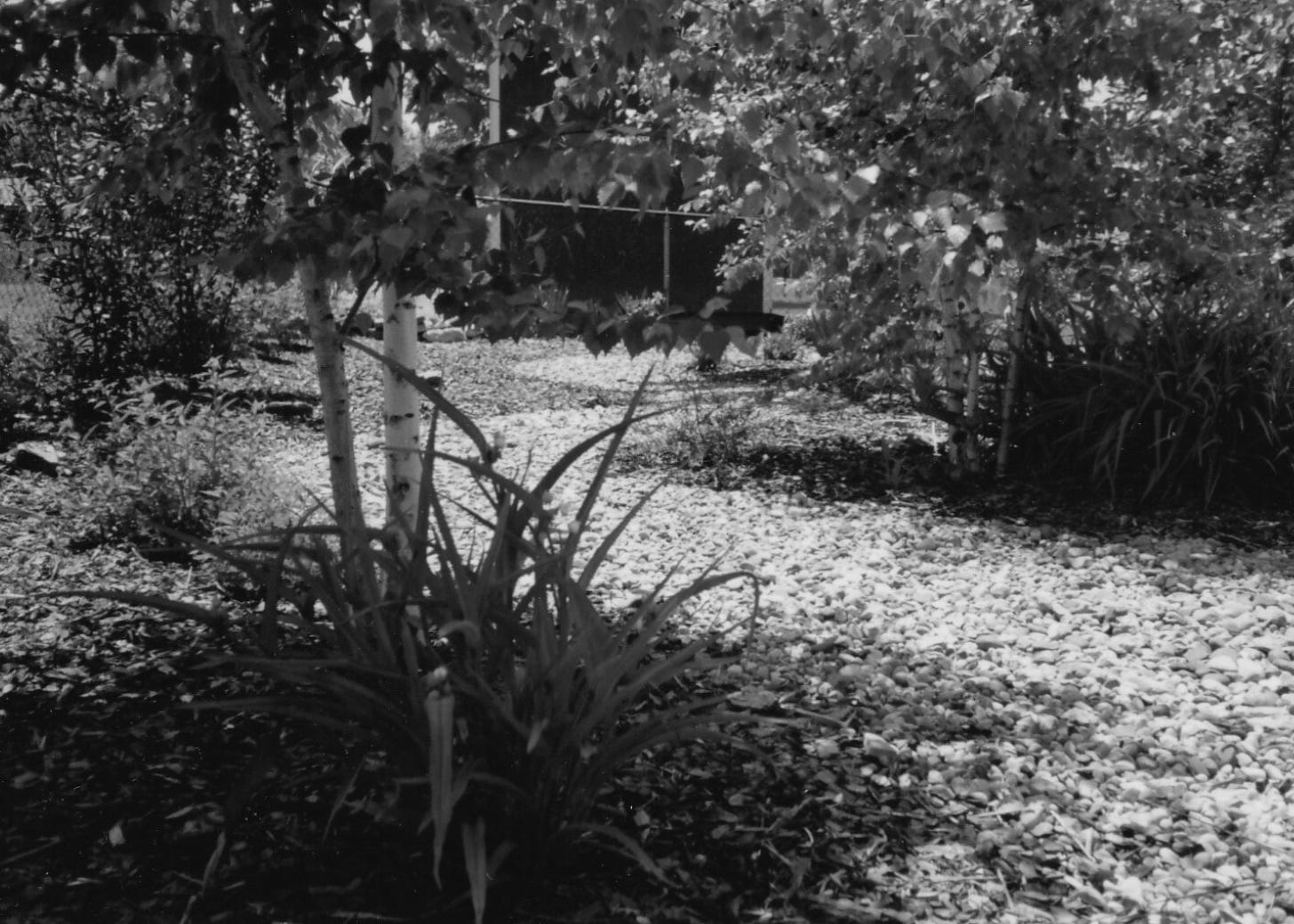
Then, in 2006, D and I divorced and I’ve mostly lived in rented properties since, where the yardwork is taken care of. Combine that with my leaving the faith for 20 years, and my spiritual connection to the natural world became even more tenuous (I’ve joked that I appreciate nature best through windowpanes and windshields). Now, however, as an agnostic who still loves Jesus, I’m regaining an interest in the “birds of the air” and the “lilies of the field.” And, fortuitously, my online friend Victoria is helping me recognize nature’s sacredness once more and, in doing so, she’s nurturing the seed Edith Schaeffer planted decades ago.
A Community of Sorts
Returning to the 1990’s, I did read Francis Schaeffer’s books as well (The God Who Is There and He Is There and He Is Not Silent), and they did impact my spiritual beliefs at that time. But it was the warm, open space Edith encouraged that gave me the most room to explore, to question, to learn…and to desire community.
“The tight little segregated life, always spent with people your own age, economic group, educational background, and culture tends to bring an ingrown, static sort of condition. Fresh ideas, reality of communication and shared experiences will be sparks to light up fires of creativity, especially if the people spending time together are a true cross-section of ages, nationalities, kindred, and tongues.” ―Edith Schaeffer, The Hidden Art of Homemaking
An actual community as described above would not begin to be realized in my own life until a few years later but, in the meantime, Edith increased my growing interest in all things creative and, in a way, helped me to form a type of figmental community with the authors, musicians, artists, and filmmakers who I came to know through their work.
Here are a few I communed with between 1991-1994.
Books
Fiction
Hannah Fowler by Janice Holt Giles (a gripping novel that portrays “a resilient pioneer woman who loses her father on the journey to the Kentucky frontier and she must rely on her own strength to survive”)
Pride and Prejudice by Jane Austen (I’m glad I didn’t read Austen until I turned 30—I don’t think I would have appreciated her witty social commentary as much before then)
Anne of Green Gables series by Lucy Maud Montgomery (I think I would have loved these if I’d read them sooner, but I’m glad I finally read them; among other things, they introduced me to the poem, "The Lady of Shalott," by Alfred, Lord Tennyson which led me to the painter, John William Waterhouse, who’s work I adored)
The Old Man and the Sea by Ernest Hemingway (this story about courage in the face of defeat was my first encounter with Hemingway’s “sparse, direct, and powerful prose,” and though I would only read one more book by him—The Sun Also Rises—his matter-of-fact writing style influenced my own)
1984 by George Orwell (also relevant in today’s political hellscape—”The Party told you to reject the evidence of your eyes and ears. It was their final, most essential command.”)
And by Charles Dickens: David Copperfield, A Tale of Two Cities, A Christmas Carol, Oliver Twist, Great Expectations (Dickens made me more conscious of societal ills caused by wealth and class)
Nonfiction
Anne Frank: The Diary of a Young Girl (gutted me but essential reading then and now)
On Writing Well by William Zinsser (insightful look at the writing craft: “Writing is hard work. A clear sentence is no accident. Very few sentences come out right the first time, or even the third time. Remember this in moments of despair. If you find that writing is hard, it’s because it is hard.”)
Elements of Style by E.B. White, author of Charlotte’s Web (the part about developing a good “ear” for good writing—rhythm, variety, emphasis, conciseness—stayed with me and I believe, along with Zinsser’s book, aided my critical thinking skills since concise, coherent writing is a result of concise, coherent thinking)
E.B. White: A Biography by Scott Elledge (after Louis L’Amour, White was the second author I came to admire who was “not conventionally religious” and a “liberal free-thinker”)
Morning Star of the Reformation: John Wycliffe by Ron O'Dell
To the Golden Shore: The Life of Adoniram Judson by Courtney Anderson
And by Elisabeth Elliot: Through Gates of Splendor, The Shaping of a Christian Family, Loneliness (I wouldn’t begin seriously deconstructing the foundations of my faith until the year of Y2K, so I continued to read plenty of Christian authors; and though I now no longer hold a number of their views, some—like Elisabeth Elliot’s emphasis on the importance of parental role modeling—still resound)
I also read both fiction and nonfiction from an author who became a dear friend—C.S. Lewis (an upcoming post will be devoted solely to him).
Music
I’ve already written here and primarily here about one of my greatest musical loves—Ludwig van Beethoven. Other composers I delighted in were: Bach, Handel, Haydn, Mozart, Chopin, Fauré, Liszt, Shubert, Schumann, Debussy, Tchaikovsky, Dvořák, Prokofiev, Stravinsky, and the mighty Rachmaninoff.
I should add that, until fairly recently (2021 to the present), I didn’t as faithfully keep track of the music and art I consumed as I did the books I read. For instance, I got the names above from an obviously old list that I’d compiled on two college-ruled pieces of paper stapled together. I don’t remember exactly when or why I jotted the information down but I do recall my “classical music” phase started in the late-80’s and continued throughout the 90’s, so I included them here.
But multiple folders are full of such papers that unfortunately I didn’t date. One is a 3x6 inch note that was once part of a memo pad (the kind with a magnet on the back) that we probably kept on the refrigerator. It says only:
Brahms — Violin Concerto No. 3 D Mino
Perlman — Violin
[Our daughter] wants to know if she can have a plain hamburger.
I must have been scribbling hurriedly since I dropped the “r” in “Minor.” And I wish I’d included more about the violin piece by Itzhak Perlman. Also, that last line was probably written to D while he was on the phone or something!
Art
John William Waterhouse (mentioned above)
Sir Lawrence Alma-Tadema (The Roses of Heliogabalus still captivates me)
Frederick, Lord Leighton (for years, we had a framed print of his “Mother and Child” painting above our living room couch)
Caravaggio (when I first learned the term “chiaroscuro”—a technique that creates strong contrasts between light and dark—I not only became enamored with Caravaggio’s use of it in the more famous The Calling of St. Matthew but also found his Saint Francis of Assisi in Ecstasy—with its possible homoerotic undertones—particularly intriguing, which may have said something about my buried interests at that time, considering how I’ve been a dedicated M/M romance reader for the last six years)
Claude Monet (of course)
And last but definitely not least, John Singer Sargent! (I love just about everything he ever created, and the book, Sargent Abroad: Figures and Landscapes, by Warren Adelson and others—which highlights lesser-known paintings from Sargent’s travels between 1900 and 1914—contains my absolute favorites)


.jpg)
Film
I’m only going to mention one movie that I watched during this period of my life and that’s because much of our visual media at the time was either Star Wars or Disney flicks (my daughter told me that she and her brothers would meet in the kitchen then march around the whole house quoting the entirety of Mulan), or it was homeschool related.
But I did see the 1987 Danish drama, Babette’s Feast. Called the “ultimate film about food,” the movie is adapted from a story by Isak Dinesen and is the “lovingly layered tale of a French housekeeper with a mysterious past who brings quiet revolution in the form of one exquisite meal to a circle of starkly pious villagers in late nineteenth-century Denmark.”
Finding beauty, art, and even spirituality, in the richness of the physical, sensual world would prove to play an important role in my journey (even though I never have been much of a cook and, as I mentioned above, I’m still working on my relationship with nature).
I’ll end with a quote from the film:
Martine: [after learning Babette spent all of her money on the dinner] Now you’ll be poor for the rest of your life.
Babette: An artist is never poor.